
How AI Is Transforming Digital Marketing
Artificial Intelligence (AI) is no longer a futuristic concept—it’s a present-day force reshaping the entire digital marketing landscape. From automating repetitive tasks to delivering hyper-personalized customer experiences, AI is empowering marketers to work smarter, faster, and more efficiently than ever before.
In today’s competitive environment, businesses that leverage AI effectively gain a significant edge. This blog explores how AI is transforming digital marketing, the most powerful tools available, and the strategies you need to stay ahead.
What Is AI in Digital Marketing?
Understanding how AI is transforming digital marketing helps businesses recognize how technology is changing the way brands attract, engage, and retain customers. AI in digital marketing involves using machine learning, data analysis, and automation tools to enhance marketing effectiveness and drive better results. It helps marketers analyze vast amounts of data, predict user behavior, understand customer preferences, and optimize campaigns in real time.
Instead of relying on guesswork, marketers can now make AI-powered, data-driven decisions with greater precision and speed. AI can identify patterns in customer behavior that may be difficult to detect manually, allowing businesses to create more relevant campaigns and improve overall marketing performance.
AI also supports marketers in automating repetitive tasks such as audience segmentation, content recommendations, email personalization, ad optimization, and customer communication. This gives marketing teams more time to focus on creativity, strategy, and building meaningful relationships with their audiences.
As AI is transforming digital marketing, businesses can use intelligent tools to deliver the right message to the right audience at the right time. This shift allows businesses to better understand their customers, anticipate their needs, and deliver highly relevant experiences that drive engagement, loyalty, and conversions.
Ultimately, AI does not simply automate marketing activities—it helps businesses make smarter decisions, improve efficiency, and create more personalized customer experiences.
1. AI-Powered Content Creation
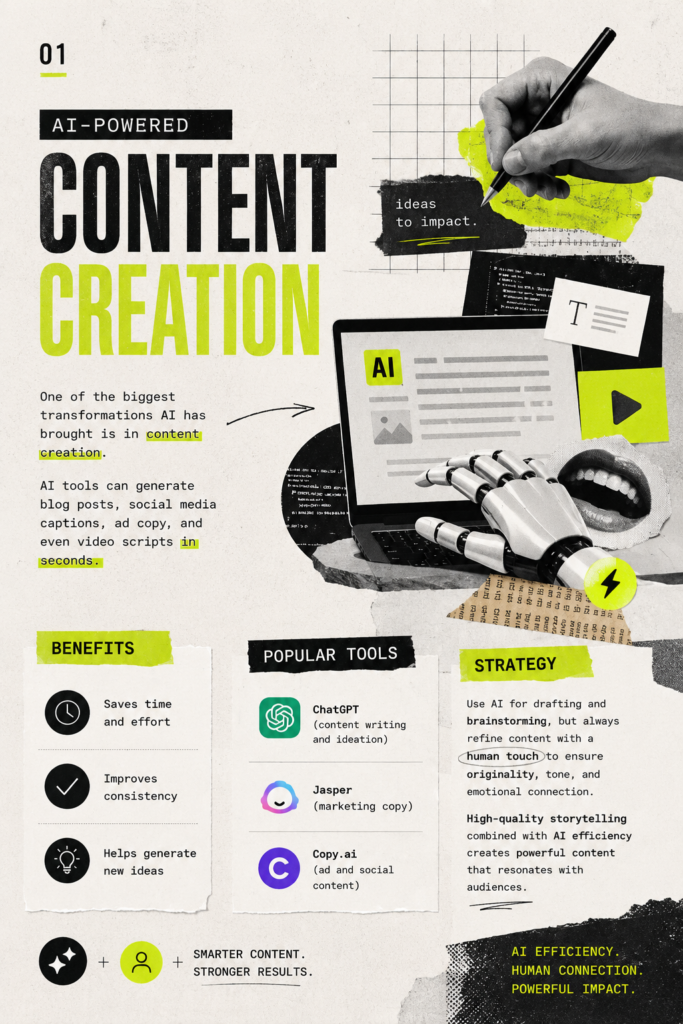
AI is transforming digital marketing by making content creation faster… One of the biggest transformations AI has brought is in content creation. AI tools can generate blog posts, social media captions, ad copy, and even video scripts in seconds.
Benefits:
Saves time and effort
Improves consistency
Helps generate new ideas
Popular Tools:
ChatGPT (content writing and ideation)
Jasper (marketing copy)
Copy.ai (ad and social content)
Strategy:
Use AI for drafting and brainstorming, but always refine content with a human touch to ensure originality, tone, and emotional connection. High-quality storytelling combined with AI efficiency creates powerful content that resonates with audiences.
2. AI-Powered Hyper-Personalization at Scale
This is another way AI is transforming digital marketing through personalized experiences. AI enables marketers to deliver personalized digital marketing experiences to thousands or even millions of users simultaneously. It analyzes user behavior, preferences, interests, browsing activity, purchase history, and interactions to tailor content, offers, product recommendations, and marketing messages to individual customers.
Traditional marketing often relies on broad audience segments, where the same message is delivered to a large group of people. AI makes personalization more precise by identifying individual patterns and preferences. This allows businesses to create more relevant experiences based on what each customer is interested in and how they interact with a brand.
AI can continuously analyze customer data and adjust marketing experiences in real time. For example, an e-commerce website can recommend products based on a customer’s previous searches or purchases. Similarly, an email marketing campaign can automatically personalize product suggestions, offers, and content based on customer behavior.
Examples:
Personalized email campaigns
Product recommendations on e-commerce sites
Dynamic website content
Strategy:
Segment your audience and use AI tools to deliver relevant messages at the right time. Personalization increases engagement, loyalty, and conversions. As AI continues to improve, real-time personalization will become even more accurate and impactful.
What AI can predict:
- Customer purchase behavior
- Campaign performance
- Market trends
Tools:
- Google Analytics (AI insights)
- HubSpot (predictive lead scoring)
- Salesforce Einstein
Strategy:
Use predictive data to optimize campaigns, allocate budgets effectively, and target high-value customers. This helps reduce risks and improve ROI across marketing efforts.
4.AI in Social Media Marketing Strategies
AI is transforming digital marketing strategies across social media platforms by helping businesses understand their audiences, create engaging content, analyze trends, automate repetitive tasks, and improve overall campaign performance. AI-powered tools can analyze large amounts of social media data to identify audience preferences, trending topics, engagement patterns, and the types of content that perform best.
AI can also help marketers determine the best times to publish content, personalize posts for different audience segments, and monitor conversations around their brand. Sentiment analysis allows businesses to better understand how customers respond to their products, services, and campaigns.
By combining automation with real-time insights, AI enables marketers to manage social media campaigns more efficiently while focusing more on creativity and strategy. This makes AI in social media marketing strategies an increasingly important part of modern digital marketing.
.
Key Uses:
- Content scheduling and automation
- Trend analysis
- Sentiment analysis
Tools:
- Hootsuite
- Buffer
- Sprout Social
Strategy:
Use AI tools to identify the best posting times, trending topics, and audience preferences to maximize reach and engagement. Social listening powered by AI can also help brands stay ahead of trends and conversations.
5 AI Chatbots and Conversational Marketing
“AI chatbots demonstrate how AI is transforming digital marketing and customer communication. They provide instant responses, guide users through the buying process, and improve customer satisfaction.
Benefits:
24/7 availability
Faster response time
Improved user experience
Examples:
Website chatbots
Messenger bots
WhatsApp automation
Strategy:
Implement chatbots to handle common queries, qualify leads, and provide support—while keeping human assistance available for complex issues. This balance ensures efficiency without sacrificing personalization.
6. AI-Driven Advertising
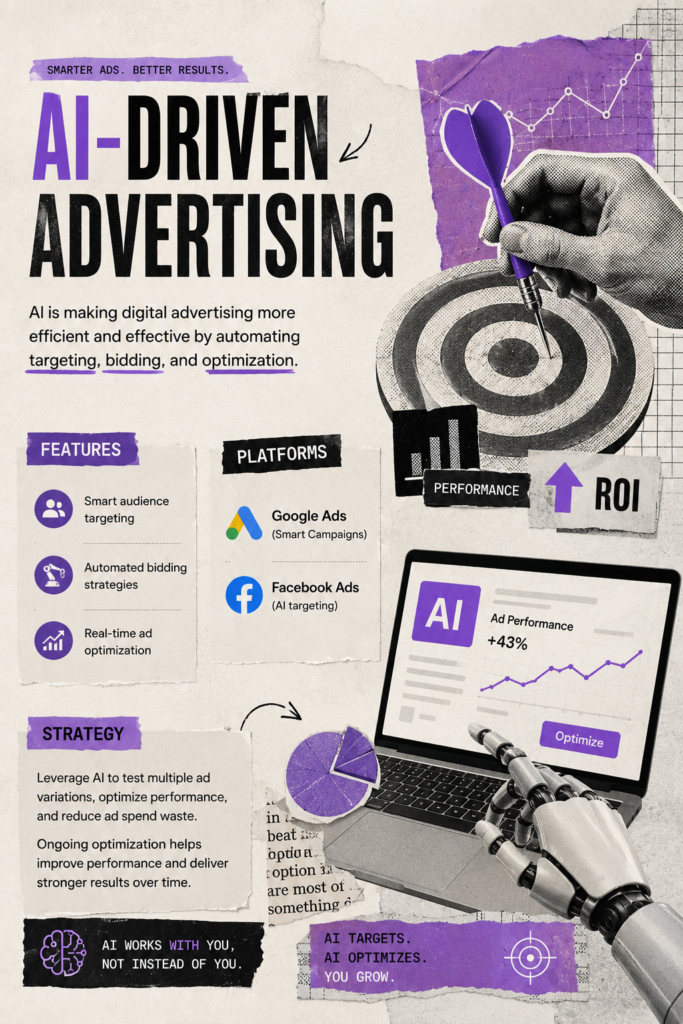
AI is transforming digital marketing by improving targeting, bidding, and ad optimization.
Features:
Smart audience targeting
Automated bidding strategies
Real-time ad optimization
Platforms:
Google Ads (Smart Campaigns)
Facebook Ads (AI targeting)
Strategy:
Leverage AI to test multiple ad variations, optimize performance, and reduce ad spend waste. Ongoing optimization helps improve performance and deliver stronger results over time.
7. AI-Powered SEO Optimization
AI is transforming Search Engine Optimization (SEO) by helping marketers understand search intent, optimize content, and track performance more effectively.
AI helps with:
- Keyword research
- Content optimization
- Competitor analysis
Tools:
- SEMrush
- Ahrefs
- Surfer SEO
Strategy:
Use AI insights to create high-quality, intent-driven content that ranks well and delivers value to users. AI also helps identify content gaps and opportunities for growth.
8. Email Marketing Automation
AI is transforming digital marketing through automated and personalized email campaigns.
Capabilities:
- Predicting best send times
- Personalizing subject lines
- Automating email sequences
Tools:
- Mailchimp
- ActiveCampaign
- Klaviyo
Strategy:
Use AI to send the right message to the right audience at the right time, increasing open rates and conversions. Personalized email journeys can significantly improve customer retention.
Benefits:
-
Identifies pain points
-
Improves user experience
-
Increases conversion rates
Strategy:
Analyze user data to refine your funnel and create a seamless journey across all touchpoints. A well-optimized journey leads to better customer satisfaction and higher lifetime value.
10. Data Analysis and Business Insights
AI can process massive amounts of data quickly and provide actionable insights that would take humans much longer to uncover. Data-driven marketing insights help marketers understand campaign performance and make more informed decisions.
Advantages:
-
Faster decision-making
-
Accurate insights
-
Real-time optimization
Strategy:
Use AI dashboards and analytics tools to monitor performance and continuously improve your campaigns. Data-driven marketing plays a crucial role in achieving long-term business success.
Challenges of Using AI in Marketing
As AI Is Transforming Digital Marketing, businesses must also consider data privacy, human creativity, and responsible AI usage:
-
Over-reliance on automation
-
Lack of human creativity
-
Data privacy concerns
Solution:
Balance AI with human strategy, creativity, and ethical practices. Marketers should focus on using AI as a support tool rather than a complete replacement for human insight. AI marketing automation should complement human decision-making, creativity, and strategic thinking.
The Future of AI in Digital Marketing
The future of AI in digital marketing will continue to show how AI is transforming digital marketing. The future of AI in digital marketing will bring new opportunities for businesses to improve personalization, automation, and customer experiences.
Future trends include:
-
More advanced personalization
-
Voice and visual AI search
-
Fully automated marketing campaigns
As AI technology grows, marketers will need to continuously upskill and adapt to new tools and strategies to remain competitive in the industry.
Final Thoughts
AI is reshaping digital marketing by enhancing efficiency, enabling deeper personalization, and driving decisions through data. It is not here to replace marketers—but to empower them.
To succeed in the AI-driven era, focus on:
Combining AI with human creativity
Leveraging data for smarter decisions
Continuously learning and adapting
The Future of AI in digital marketing belongs to those who can harness the power of AI while maintaining a human connection with their audience.
Businesses that invest in AI today are not just improving their marketing—they are preparing for the future. Early adopters will have a clear advantage in building stronger customer relationships and achieving sustainable growth.
Start integrating AI into your strategy today—and unlock the next level of digital marketing success.
author: Anuvind